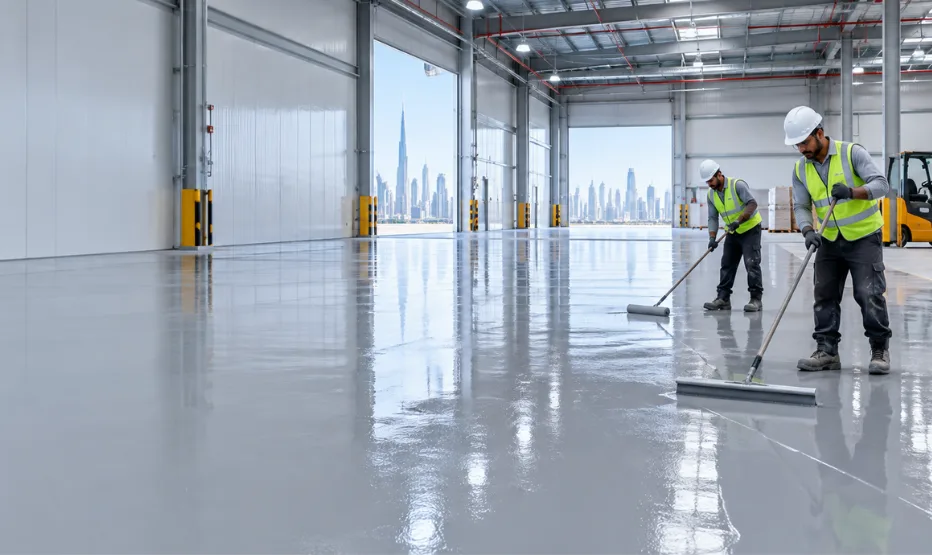
Industrial Flooring Installation for Heavy-Duty Sites
Car parks, workshops, hotel kitchens, and electronics assembly rooms all sit on concrete, yet each one asks something different from it. Industrial flooring installation starts with naming that difference. A coating picked for oil and solvent exposure does not automatically control static, and a static-control floor solves a different problem from a car park deck.
Epoxy Flooring Dubai Facilities Use for Wear and Chemicals
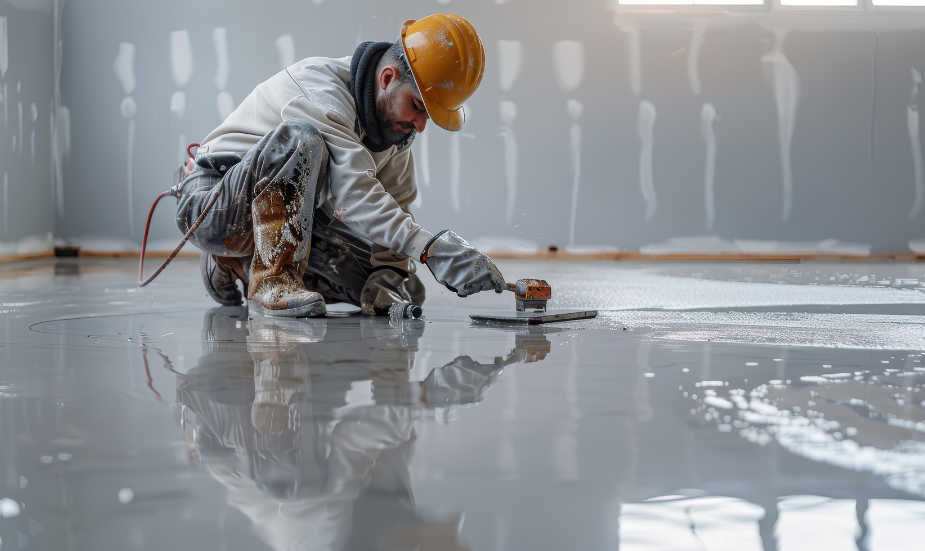
Epoxy is the system most people picture first. Installers build it up in layers of resin over a prepared surface, which leaves a smooth, joint-free finish that resists stains, wear, and a range of chemicals. Epoxy flooring Dubai resists oils, solvents, and acids, and lists car parks, workshops, commercial spaces, and industrial units among the places it goes.
Epoxy has limits, and a fair article says so. Sunlight can yellow or chalk it. Scratches show up in busy zones. Adhesion depends on how well the concrete was prepared, and professional application is often needed.
Floor Coating Services: Matching Thickness to the Job
Floor coating services cover a wide range, from a 2 mm self-levelling epoxy layer to heavy-duty 5 mm epoxy and polyurethane screeds. Hotel kitchens show why the choice matters. The company describes epoxy screed as hygienic and suited to foot traffic, impact, and chemicals, while PU screed is positioned for wet and greasy areas because of its slip resistance and abrasion tolerance.
Floor hardening and self-levelling sit alongside these systems. They are described as ways to improve the strength of existing concrete floors under heavy traffic.
Thicker is not automatically better. Load, moisture, cleaning routine, and slip risk all point toward different systems.
Antistatic Floor Coating in Dubai for Sensitive Environments
Static is a quieter hazard than a chemical spill, but electronics feel it first. Electrostatic discharge is the rapid transfer of charge between two bodies at different electrical potentials, a definition used by the ESD Association.
Antistatic floor coating in Dubai is aimed at laboratories, electronic assembly areas, food packaging units, factories, and data centres. The conductive or dissipative properties of the flooring carry accumulated charge away, which protects both equipment and the people working near it. The company’s system pairs a conductive carbon fibre grid with a resin matrix.
Carbon fibre plate and wrap are a separate reinforcement method for concrete floors and steel deck slabs, described as thin, light, and resistant to chemical corrosion. ESD requirements vary by facility, so an electrical or ESD specialist should confirm the specification before anything is ordered.
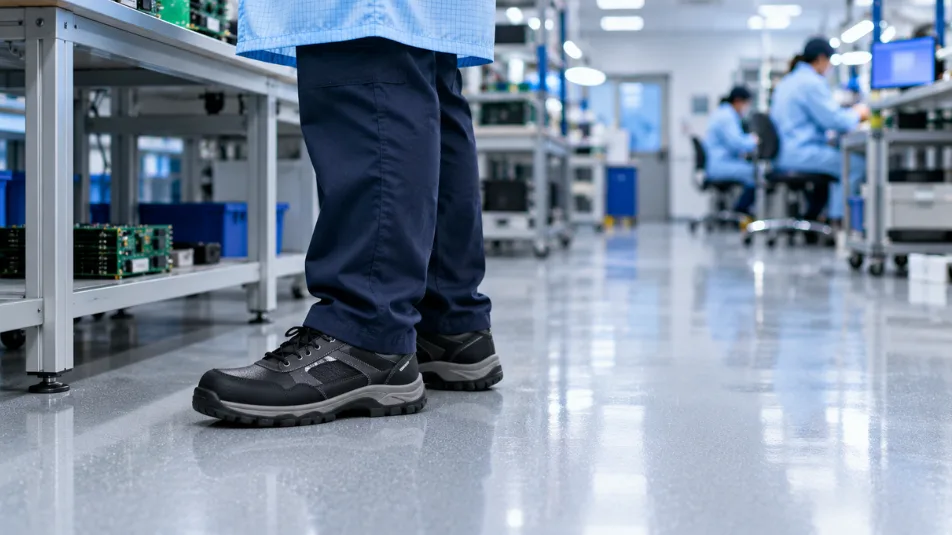
Planning Your Industrial Flooring Installation
Start with the concrete. Surface preparation shapes how well any coating bonds, and industry guidance grades the texture of prepared concrete on a numbered profile scale. Cracks and spalls belong to a repair conversation first, and the company lists concrete repair as its own service.
Then list what touches the floor. Chemicals, forklifts, water, sunlight, cleaning frequency, and static-sensitive equipment each narrow the options. Any industrial flooring installation that skips this list risks a system chosen for the wrong stress.
Contractor checks come last. Ask for licenses and certifications, proof of insurance, warranty terms in writing, examples of past work, and a detailed estimate. Cost against tile depends on the tile and the floor area, so compare quotes for your own site instead of relying on averages.
This article gives general information. It is not engineering or safety advice, and product suitability should be confirmed by a qualified professional for your facility.
Final Thoughts
Heavy-duty floors succeed when the system matches the stress, not when the coating sounds the toughest. Chemical exposure, wet kitchens, and static-sensitive rooms each point somewhere different. Which of those three describes the floor you are planning?
FAQ
Depends on the traffic. Epoxy resists chemicals, stains, and wear, and it cleans easily. Sunlight can yellow it, and scratches happen. Get a site inspection before you decide.
Think of it as a drain for static charge. Conductive or dissipative properties move charge away safely, so equipment and operators stay protected in labs, electronics assembly, and similar rooms.
Look at what hits the floor daily. PU screed is described as better for water and grease because of its slip resistance. Epoxy screed handles foot traffic, impact, and chemicals. Ask your contractor to compare both for your layout.
It varies. Tile type and floor size change the math. Epoxy can work out cost-effective because it goes down quickly and needs little upkeep, but get itemized quotes for both.
Licenses and certifications first. Then insurance, warranty terms, photos of past jobs, and a written estimate. Also notice whether they explain surface preparation without being asked.